
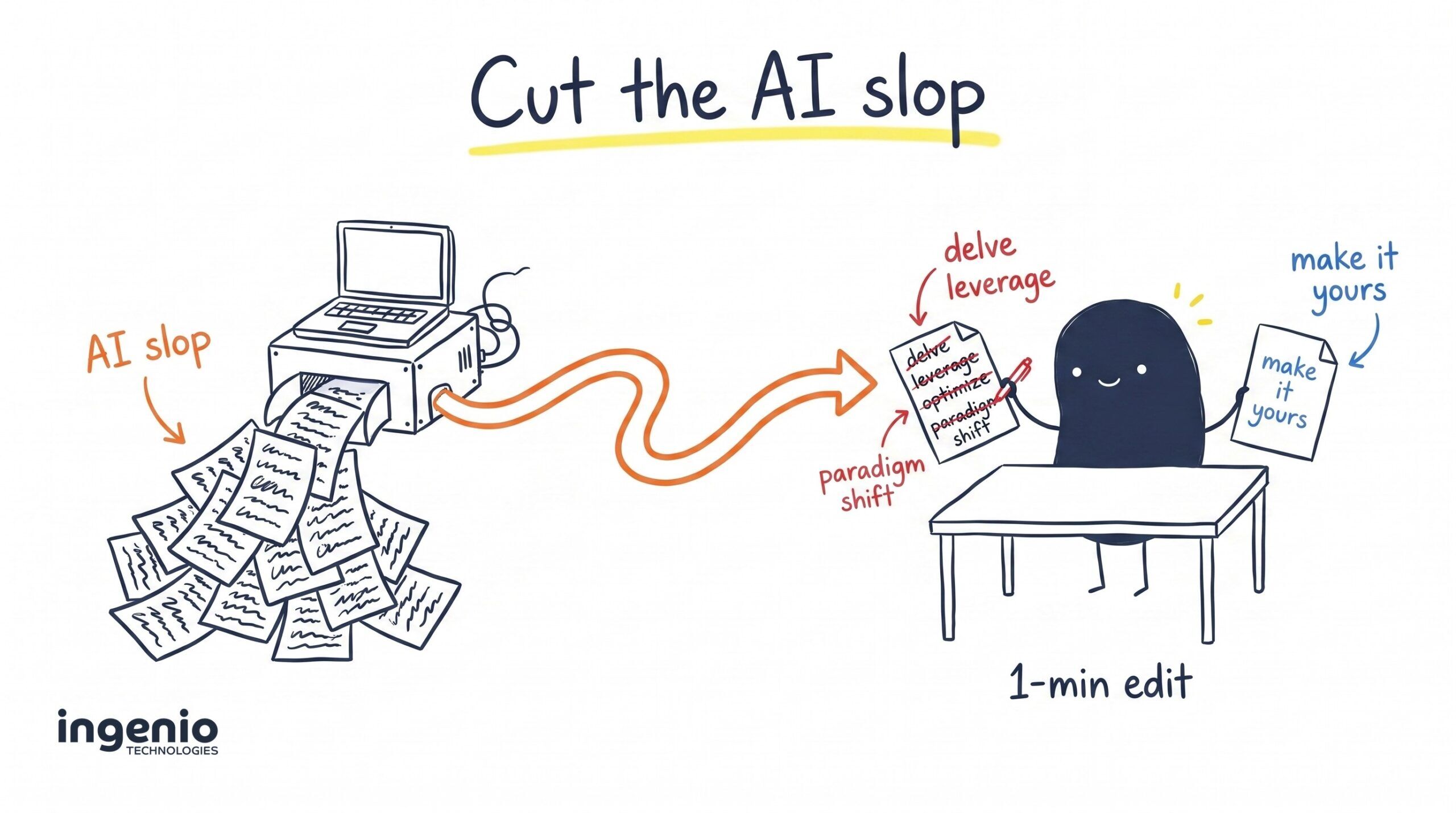
Open LinkedIn, read a blog or run a quick search, and you will hit it within seconds: AI slop. Fake product photos, invented quotes, articles that say nothing in 800 words, videos of people who never existed. It is cheap to make, it is everywhere, and it is quietly changing what the internet feels like to use.
Most of it is someone else’s problem. But a smaller version of the same thing lands on your own desk, and it carries your name. A newsletter, a client update or a proposal that an AI wrote and nobody edited. Researchers have a name for that one: workslop.
This is a plain guide to both, from our team in Brighton. What AI slop is, why there is suddenly so much of it, and how to use AI for your own writing without adding to the pile.
What is AI slop?
AI slop is low-quality, AI-generated content produced in bulk with little care or checking: images, video and text churned out by generative AI to fill a feed, game a search result, or turn a quick profit. The word “slop” is the point. It is the AI version of spam. Both Wikipedia and the Cambridge Dictionary now carry an entry for it.
What AI slop looks like
Once you know the term, you see it everywhere. This kind of synthetic media takes a few main forms, across image and video as well as text:
- AI-generated images and video: the “shrimp Jesus” pictures on Facebook, fake disaster photos, deepfakes of politicians made to mislead voters.
- Low-effort articles written for search engines, thin on facts and stuffed with keywords, sometimes with the chatbot’s own “as an AI language model” left in by accident.
- Fake reviews, AI spam and clickbait comments from bot accounts, clogging up social media feeds.
- Whole websites of AI content wrapped around adverts, built to earn a little advertising revenue from anyone who clicks.
Some of it is a harmless laugh. A lot of it is not. When AI generated content is used to spread misinformation or disinformation, or a deepfake is passed off as real, low quality stops being the worst part of the problem.
Why there is suddenly so much of it
Because it is nearly free to make, and it sometimes pays. Large language models (LLMs) and image generators can produce endless AI images and AI video in seconds, so one person can flood a platform on their own. The reward is attention: clicks, views, followers and advertising revenue. Most people making AI slop just want to hold your eye long enough to earn from it. Generative AI handed the attention economy a bottomless supply of low-quality content, and search results and social media feeds are still working out how to cope.
You can see how the incentives work. AI-powered content farms spin up entire websites of low-quality AI articles to chase SEO rankings and advertising revenue. On YouTube, TikTok and Meta Platforms, AI art and AI-generated slop that went viral earns real money, because the creator economy rewards volume, and the algorithm cannot tell careful work from a flood of it.
A lot of it is built to fool people. Fake social media accounts post AI slop to whichever platform will take it, farming reach from users who cannot easily tell what is real.
Workslop: AI slop with your name on it
The internet-wide flood is one thing. The version that costs your business is quieter, and it does not come from spammers. It comes from good people using AI in a hurry and sending the first draft straight on.
What is workslop?
Workslop is AI-generated content that looks like decent work but carries no real substance, so it pushes a task backwards instead of forwards. The person who receives it has to redo it, chase the missing detail, or fix the inaccuracy. Researchers at BetterUp Labs and Stanford’s Social Media Lab coined the term in Harvard Business Review in September 2025.
In their survey of 1,150 US desk workers, 40% said a colleague had sent them workslop in the past month. Each time, it took them close to two hours to sort out, which the researchers put at roughly $186 per employee per month (BetterUp Labs and Stanford Social Media Lab, Harvard Business Review, 2025). It is a US, self-reported survey, so treat it as a signal, not a law. The point still holds: careless AI writing does not save time. It moves the work to someone else.

Your clients can already spot it
The bigger cost is reputational. A generic, AI-shaped email or proposal tells a client you could not be bothered, even when you worked hard on the rest of the job.
One AI-detection firm, Originality.ai, ran its detector over 3,368 long LinkedIn posts from 99 high-profile accounts in 2025 and flagged 53.7% as likely AI-written. That number needs a caveat: it is an automated guess from a company that sells detection, checking a small group of big names, not proof and not everyone. But you have probably felt it yourself while scrolling. The bland opener. The tidy three-point list. The words no one says out loud. Once you notice the pattern, you cannot unsee it, and neither can your clients.
Platforms are starting to react. In July 2026, Substack added a feature, powered by a tool called Pangram, that lets readers scan a post and see an estimate of how much was written by AI. Its chief executive framed it as a stand against “slop” and against passing AI text off as human. These detectors are not always right, and they can mistake careful human writing for AI. So skip the scanner worry and write things worth reading.
What makes writing sound like AI
AI writing has a tell, or rather a cluster of them. None is damning on its own, but together they are the sound of a machine:
- An opener that clears its throat instead of making the point.
- Everything in neat threes, every paragraph the same length.
- Buzzwords you would never say aloud: “delve”, “leverage”, “robust”, “seamless”, “unlock”, “foster”, “synergy”.
- The “it’s not just X, it’s Y” pattern, over and over.
- An em dash joining half the sentences.
- No specifics. No number, no name, no real example. Nothing only you would know.
Openers to avoid
The throat-clearing intro, warming up instead of starting:
“In today’s fast-paced world, communication has never been more important.” “In an increasingly digital landscape…” “We’ve all been there.”
The rhetorical question, asking something the reader never asked:
“Ever wondered what makes a great newsletter?” “What if there was a better way to write?” “Struggling to keep on top of your inbox?”
Keep using AI. Just reserve it for the part it is good at, the first draft, and take over for the part it is bad at: sounding like you, and being right.
Using AI for business writing: the do’s and don’ts
| Do | Don’t |
|---|---|
| Use AI for the first draft, then edit it as yourself. | Publish the first draft untouched. |
| Lead with your main point, in plain words. | Open with a throat-clearing intro or a rhetorical question. |
| Add the detail only you know: a name, a number, what actually happened. | Let it pad the page with generic filler. |
| Read it aloud. If it sounds like a brochure, rewrite it. | Keep sentences no one would ever say out loud. |
| Check every fact, name and figure yourself. | Trust AI on the details; it invents them with confidence. |
| Keep client and personal data out of public chatbots. | Paste confidential information into a free chatbot to “tidy it up”. |
Anything you paste into a public chatbot can be used to train it, so a client’s contract or a colleague’s personal details do not belong there. Plenty of teams already do this without telling anyone, which is why we wrote about shadow AI, and it is worth agreeing the rules before someone learns the hard way.
For your business
Nobody minds that you used AI. They mind receiving something generic or wrong. Draft with the machine, then make it sound like a person wrote it, because a person is about to read it.
A prompt you can paste into your AI tool
Most AI slop comes from a lazy instruction: “write me a post about X”. Give the tool a proper brief and the first draft comes back far closer to something you would actually send. We put the whole brief on one page you can keep.
The card tells ChatGPT or Claude to write in plain English, lead with the point, drop the buzzwords, keep client data out, and never invent a fact. It also has a short do and don’t list, and a 30-second check to run before you hit send. It is free to download and yours to keep, or you can copy the prompt straight into ChatGPT or Claude.
Download the Human AI Writing Card (PDF)
How we help
We use AI every day at Ingenio, and we built our own writing standard to keep it useful. The same idea works for any small business in Brighton, Sussex or beyond: AI is a good drafting tool and a poor final author.
If your team is leaning on it for client emails, proposals and posts (or wondering where Microsoft Copilot fits), two questions are worth answering out loud. What does “good enough to send” look like? And what should never be pasted into a public tool in the first place? The second is where writing meets security. That is really the start of an AI policy: a few plain rules for the use of AI at work, backed up with staff training, and the kind of thing we help clients think through before it becomes a problem.
Frequently asked questions
What is AI slop?
AI slop is low-quality, AI-generated content made in bulk with little care: images, video and text produced by generative AI to fill a feed, game a search result or earn quick advertising revenue. It is the AI version of spam, and the word is now in the Cambridge Dictionary.
What is an example of AI slop?
Common examples are the “shrimp Jesus” images on Facebook, deepfake videos of politicians, fake product photos, and low-effort articles written for search engines rather than readers. In a work setting, the example is “workslop”: an AI-written email or report that looks fine but wastes the reader’s time.
Why are people making AI slop?
Mostly for attention and money. Generative AI makes content almost free to produce, so a single person can churn out huge amounts of it to win clicks, views and advertising revenue. The aim is rarely to inform anyone; it is to catch the eye long enough to earn from it.
Can AI detectors tell if I used AI?
Not reliably. Even OpenAI withdrew its own detector in 2023 because it was too inaccurate to be useful; at launch it caught only about a quarter of AI text. Newer tools like Pangram are better, but they still misfire, sometimes flagging careful human writing as AI. The safer goal is writing that is clear and accurate, so it does not matter who checks.
Is it OK to use AI for client emails and proposals?
Yes, as a drafting tool, with two rules. Edit the draft so it sounds like you and every fact is correct, and never paste confidential client information into a public chatbot, because it can be used to train the model. Used that way, AI saves time without putting your reputation or your data at risk.
Which words make writing sound like AI?
The usual giveaways are “delve”, “leverage”, “robust”, “seamless”, “unlock”, “foster” and “synergy”, along with openers like “in today’s fast-paced world” and the “it’s not just X, it’s Y” pattern. Overused em dashes are another. None is wrong on its own; it is the cluster that reads as machine-written. If it is a word you would not say to a colleague, cut it.
Final thought
AI is worth using. It drafts fast, it gets you past the blank page, and it takes the grind out of a first pass. The mistake is sending what it gives you straight out the door. A few minutes of editing is the difference between something that sounds like you and one more piece of AI slop with your name on it.
If you want a hand setting sensible rules for AI use at your business, from what “good” looks like to what should never go near a public tool, we’re happy to talk it through. 👉 Get in touch with our Brighton team.

